In 1943, during the German occupation of Denmark, ten-year-old Annemarie learns how to be brave and courageous when she helps shelter her Jewish friend from the Nazis.
Number the Stars
By: Lois Lowry
Boston : Houghton Mifflin Co., 1989.
Grade level 5.8
Includes bibliographical references (p. 160). Simon, a young Polish Jew, and his family are forced by Nazis to leave their home for the filth and hunger of the Warsaw ghetto then, when his family is all taken away, he escapes to fight for survival in the countryside. Includes facts about the Holocaust.
Simon's escape : a story of the Holocaust By: Bonnie Pryor Enslow, p2011, c2011
Reading Level 4.7
Interest 3-6
The author's mother's 1938 autograph book filled with inscriptions from family and friends is the inspiration for a collection of narrative poems about life in Nazi Germany for a Jewish family trying to escape the horrors.
The year of goodbyes : a true story of friendship, family, and farewells
By: Debbie Levy
New York : Disney-Hyperion Books, c2010.
Reading Level 5.8
A meditation on a woman's hat once on display in the Jewish Historical Museum in Amsterdam.
Who was the woman who wore the hat?
By: Nancy Patz
New York : Dutton Books, 2003.
Reading Level 3.2
The power of verse to encompass a topic of mammoth scope and render it into painstakingly personal detail is keenly demonstrated in this absorbing and well thought-out anthology of grief. Sixty-two poets of different ages, citizenships and perspectives make their voices heard. There is Primo Levi on being an Auschwitz survivor; Randall Jarrell speaks in the voice of a death-camp worker. There are poems that have no need for complexity of form or vocabulary. Poets from Eastern and Western Europe, Russia, Israel and the U.S. declare the simple truths that propel the reader through the eight parts of this collection, each section a stage marked with a title of forewarning, beginning with ``Alienation'' and ``Persecution,'' on to ``Lessons'' and, finally, ``God.'' We learn what was left of the body--smoke, empty shoes, ``a faded plait/ a pigtail with a ribbon''--and we uncover what was freed of the poet's mind--rage, testimony, legacy.
Holocaust poetry Compiled and Introduced by Hilda Schiff New York : St. Martin's Press, 1995. Reading Level AD
A selection of children's poems and drawings reflecting their surroundings in Terezin Concentration Camp in Czechoslovakia from 1942 to 1944.
I never saw another butterfly : children's drawings and poems from Terezin Concentration Camp, 1942-1944 FollettBound Sewn Expanded 2nd ed. / by the United States Holocaust Memorial Museum. xxii, 106 p. : col. ill. ; 27 cm.
Young Adult
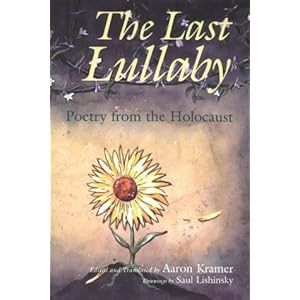
The Last Lullaby is the culmination of Aaron Kramer's fifty years devoted to translating poetry spawned by the Holocaust. The full horror of the genocide and the sublime spirit of those who resisted are given voice on these pages. These poets -- originally writing in Yiddish -- speak from the ghettos, way-stations, death camps, and partisan forests.<P>Placing each group in its historic and literary content with comprehensive introductory essays, Professor Kramer presents works mostly unavailable in English -- until now. For the very first time, readers can become familiar with poets who experienced the horrors of the ghettos and the death camps and survived: Soviet poets; American poets who were forever transformed by the Holocaust. Kramer also introduces the 1944 Terezin opera Der Kaiser yon Atlantis.<P>The Last Lullaby is a testament to the richness of a half-annihilated language that, in the pain of its survivors, was made more beautiful than ever before. Unlike most other current translators,Kramer insists on maintaining the music of the original Yiddish, the often "folkish" cadence and rhyme which, he believes, are a precious part of these poems' legacy.
The last lullaby : poetry from the Holocaust Publisher's Hardcover, 1st ed. xix, 256 p. : ill ; 24 cm. Young Adult
A grandmother tells her granddaughter the story of the charm bracelet that represent her own childhood experiences while she and her family tried to evade the Nazis in Italy during World War II.
I Will Come Back For You
By: Marisabino Russo
New York : Schwartz & Wade, 2011.
Reading Level 2.9
In 1938 Berlin, Germany, a cat sees Rosenstrasse change from a peaceful neighborhood of Jews and Gentiles to an unfriendly place where, one November night, men in brown shirts destroy Jewish-owned businesses and arrest or kill Jewish people. Includes facts about Kristallnacht and a list of related books and web resources.
Benno and the Night of the Broken Glass
By: Meg Wiviott Illustrated by: Josee Bisaillon
Minneapolis, MN : Kar-Ben Pub., 2010.
Reading Level 3.1
After many years of watching the solemn lighting of seven candles at Rosh Hashanah, Eli finally learns how those candles represent his family's connection to the Holocaust in Lithuania.
Eli Remembers
By: Ruth Vander Zee Illustrated by: Bill Farnsworth
Grand Rapids, Mich. : Eerdmans Books for Young Readers, 2007.
Reading Level 5.4
The life of Anne Frank, from birth until being taken from the hidden attic by the Nazis, is presented in this haunting, meticulously researched picture book. It is a compelling yet easy-to-understand "first" introduction to the Holocaust as witnessed by Anne and her family.
Anne Frank
By: Josephine Poole Illustrated by: Angela Barrett
New York : Alfred A. Knopf, 2005.
Grade Level 3-6
Reading Level 3.8
Two Jewish sisters, escapees of the infamous Warsaw ghetto, devise a plan to thwart an attempt by the Gestapo to intercept food bound for starving people behind the dark Wall.
The cats in Krasinski Square
By: Karen Hesse Illustrated by: Wendy Watson
New York : Scholastic Press, 2004.
Grade Level 3-6
Reading Level 4.3
Traces the life of the young Jewish girl whose diary chronicles the years she and her family hid from the Nazis in an Amsterdam attic.
A Picture Book of Anne Frank
By: David A. Adler Illustrated by: Karen Ritz
New York : Holiday House, c1993.
Reading Level 5.2
Disguised as a nurse, Irena Sendler covertly rescued nearly four hundred children from the Warsaw ghetto, smuggling them out in trucks, potato sacks, and coffins; teaching them Catholic prayers to disguise their origin; and finding them shelter in homes and convents. Farnsworth's dramatic oils convey the danger and urgency of Sendler's mission, which Rubin details with brisk clarity.
Irena Sendler and the children of the Warsaw Ghetto
By: Susan Goldman Rubin Illustrated By: Bill Farnsworth
New York : Holiday House, c2011.
Grade Level 4-7
Reading Level 5.9
The story of Irena Sendler, a Polish Catholic social worker who helped rescue nearly 2500 Jewish children from the Warsaw Ghetto in Nazi-occupied Poland during World War II.
Irena's Jars of Secrets
By: Marcia Vaughan Illustrated By: Ron Mazellan
New York : Lee & Low Books, 2011.
Reading Level 6.2
A woman recalls how she was thrown from a train headed for a Nazi death camp in 1944, raised by someone who risked her own life to save the baby's, and finally found some peace through her own family.
Every year a family celebrates Hanukkah by retelling the story of how Grandma and her sister managed to mark the day while in a German concentration camp.
One Candle
By: Eve Bunting Illustrated By: K. Wendy Popp
[New York] : Joanna Cotler Books, c2002.
Reading Level 2.9
A young girl named Rose Blanche watches as the streets of her town fill with German soldiers and tanks. Then, one day, she follows a truck into the woods, where she discovers a terrible secret. This acclaimed book, illustrated by Hans Christian Andersen Award winner Roberto Innocenti, contrasts the innocence of childhood with the horrors of war
From 1942 to 1944, twelve thousand children passed through the Theresienstadt internment camp on their way to Auschwitz. Only a few hundred of them survived the war. In the mid-1990s, German journalist Hannelore Brenner met ten of these child survivors--women in their late seventies today. Weaving these interviews with excerpts from diaries that were kept secretly during the war and samples of the art, music, and poetry created at Theresienstadt, Brenner gives us an unprecedented picture of daily life there, and of the extraordinary strength, sacrifice, and indomitable will that combined to make survival possible.
The Girls of Room 28
By: Hannelore Brenner-Wonschick
Detroit : Thorndike Press, 2009.
Reading Level AD
"Drawing on the unique historical sites, archives, expertise, and unquestioned authority of the Anne Frank House in Amsterdam, the New York Times bestselling authors Sid Jacobson and Ernie Colon have created the first authorized graphic biography of Anne Frank. Their account is complete, covering the lives of Anne's parents, Edith and Otto; Anne's first years in Frankfurt; the rise of Nazism; the Franks' immigration to Amsterdam; war and occupation; Anne's years in the Secret Annex; betrayal and arrest; her deportation and tragic death in Bergen-Belson; the survival of Anne's father; and his recovery and publication of her astounding diary. Carefully researched for historical authenticity, the book includes numerous panels featuring images that have been painstakingly adapted from rare photographs of Anne and her family. A remarkable collaboration of talent, Anne Frank: The Anne Frank House Authorized Graphic Biography not only reflects the dedication of its authors but marks another milestone in the evolution of graphic nonfiction"
Anne Frank:the Anne Frank House authorized graphic biography By: Sid Jacobson and Ernie Colón
New York : Hill and Wang, 2010.
Reading Level 6.3
Grade Level 6-12
Night offers a personal and unforgettable account of the appalling horrors of Hitler's reign of terror. Through the eyes of 14-year-old Eliezer, we behold the tragic fate of the Jews from the little town of Sighet, Even as they are stuffed into catte cars bound for Auschwitz, the townspeople refuse to believe rumors of anti-Semitic atrocities. Not until they are marched toward the blazing crematory at the camp's "reception center" does the terrible truth sink in.
Night By: Elie Wiesel
New York : Bantam Books, 1982, c1958
Reading Level 7.2
Grade Level 6-12
Krystyna Chiger describes growing up during the Holocaust in Lvov, Poland, and details her memories after her family decided to go into hiding inside the city's sewer system, and describes Leopold Socha, the Polish Catholic man--and former thief--who risked everything to help them.
The Girl in the Green Sweater: A life in Holocaust's shadow
By: Krystyna Chiger with Daniel Paisner
New York : St. Martin's Griffin ; Godalming : Melia [distributor], 2009.
Reading Level 8.6
A collection of gripping true-life accounts of children struggling through and surviving the Holocaust. By her ninth birthday, Halina Litman understood what her Jewish faith meant to the German occupiers of her town: death. Would she be able to escape? Follow Halina's gripping story, along with other incredible, true-life accounts of children in the Holocaust.These survivors put up secret resistance, used false identities, and deceived the Nazis. Through the remarkable kindness of others and their own inner strength, these children found a way to make it through the horrors of the war. These enduring stories will captivate you and remind you of the power of hope.
Escape : Children of the Holocaust By: Allan Zullo Scholastic, p2011, c2009
Reading Level 6.3
Interest 3-6
A Thousand Darknesses : Lies and Truth in Holocaust Fiction By: Ruth Franklin Oxford ; New York : Oxford University Press, 2011. Reading Level: 8 Young Adult
Operation Exodus : from the Nazi death camps to the promised land : a perilous journey that shaped Israel's fate
By: Gordon Thomas
New York : Thomas Dunne Books / St. Martin's Press, 2010.
Young Adult
A cobblestone road. A sunny day. A soldier. A gun. A child, arms high in the air. A moment captured on film. But what is the history behind arguably the most recognizable photograph of the Holocaust? Dan Porat unpacks this split second that was immortalized on film and unravels the stories of the individuals--both Jews and Nazis--associated with it. The book presents the stories of three Nazi criminals, ranging in status from SS sergeant to low-ranking SS officer to SS general. It is also the story of two Jewish victims, a teenage girl and a young boy, who encounter these Nazis in Warsaw in the spring of 1943. The book is remarkable in its scope, picking up the lives of these participants in the years preceding World War I and following them to their deaths. One of the Nazis managed to stay at large for twenty-two years. One of the survivors lived long enough to lose a son in the Yom Kippur War. Nearly sixty photographs dispersed throughout help narrate these five lives. And, in keeping with the emotional immediacy of those photographs, Porat has deliberately used a narrative style that, drawing upon extensive research, experience, and oral interviews, places the reader in the middle of unfolding events.
The boy : a Holocaust story By: Dan Porat New York : Hill and Wang, 2010.
Relates the stories of courageous non-Jewish teenagers who rescued Jews from the Nazis.
Rescuers Defying the Nazis : Non-Jewish teens who rescued Jews
By: Toby Axelrod
New York : Rosen Pub. Group, 1999.
Lexile 870
In this unit, students explore a variety of resources like texts, images, sounds, and photos to learn more about the Holocaust.
The Holocaust is a period in human history that shows the extreme levels to which people can act on racial prejudice. The death camps were places like Auschwitz and Birkenau where the prisoners were transported for the sole purpose of being killed. The Nazis used methods such as gassing to exterminate large numbers of people and showed no mercy even toward children.
This theme will address:
Confronting change and loss
Responding to unfairness and danger
Displaying courage and resourcefulness
Recognizing how lives can be changed by people and events
Becoming aware of political and social decisions that affect the quality of life
Learning how diverse groups adapt to new environments
Recognizing the importance of participation in the community
Becoming aware of ethical and unethical uses of power
Being responsible for members of the community
Rejecting stereotypes and prejudice
Promoting tolerance, understanding, and acceptance
Middle school students (grades 5-8) begin to learn about prejudice and the harm it causes. They will learn to question and react to literature about the Holocaust. In addition, they will recognize humane and inhumane behaviors that people are capable of.
 I Never Saw Another Butterfly